Cricket is one of the world’s most popular sports with over 2.5 billion fans globally, yet many beginners find the rules confusing and complicated. If you’ve ever watched a cricket match and wondered “what just happened?” or “why did the umpire raise his finger?” – this complete guide explains all basic rules of cricket in simple, easy-to-understand language perfect for absolute beginners who have never played or watched cricket before.
The basic rules of cricket are actually quite simple once you understand the key concepts: two teams of 11 players each take turns batting and bowling, the batting team tries to score as many runs as possible while the bowling team tries to get them “out” by hitting the wickets or catching the ball. The team with the most runs at the end wins the match. Sounds simple, right? Well, there’s a bit more to it, but don’t worry – we’ll explain everything step by step with pictures and examples.
This comprehensive beginner’s guide covers everything you need to know about cricket including how cricket is played, what equipment is used, how scoring works, what are overs and wickets, all the different ways a batsman can get out, fielding positions explained with diagrams, basic cricket terminology, different formats of cricket (Test, ODI, T20), and simple tips for understanding what’s happening when you watch a cricket match. By the end of this article, you’ll be able to watch IPL or international cricket matches and actually understand what’s going on!
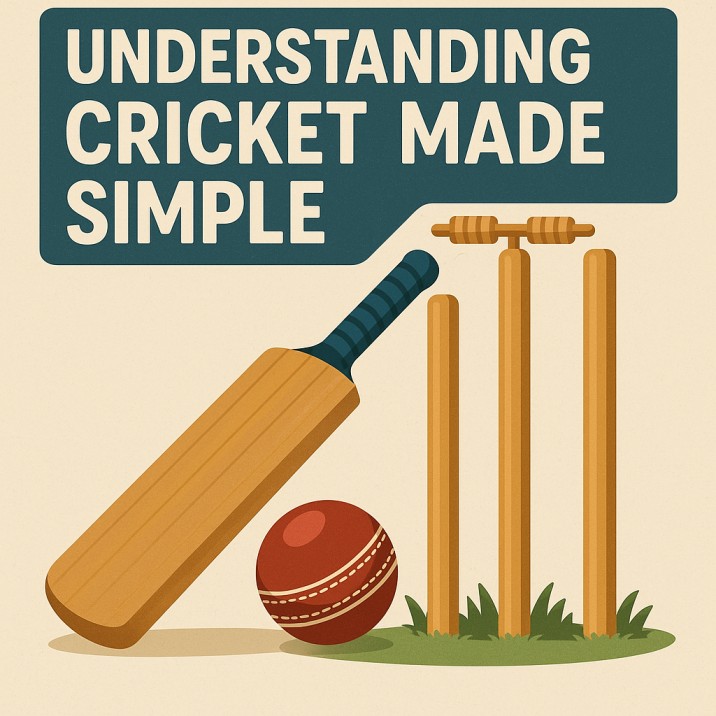
A simple visual guide explaining the basics of cricket for beginners.
What is Cricket? Simple Explanation for Complete Beginners
Cricket is a bat-and-ball sport played between two teams of 11 players each on a large oval-shaped field with a rectangular 22-yard pitch in the center. The game revolves around one team (batting team) trying to score runs by hitting the ball, while the other team (bowling/fielding team) tries to prevent runs and get the batsmen out.
The Basic Concept
Think of cricket like this simple analogy: Imagine you’re trying to defend your house (the wickets) from someone trying to knock it down (the bowler), and while defending, you also try to run back and forth to score points (runs). The bowler wants to knock down your house or trick you into making a mistake so you get out, while your job is to protect your house and score as many runs as possible.
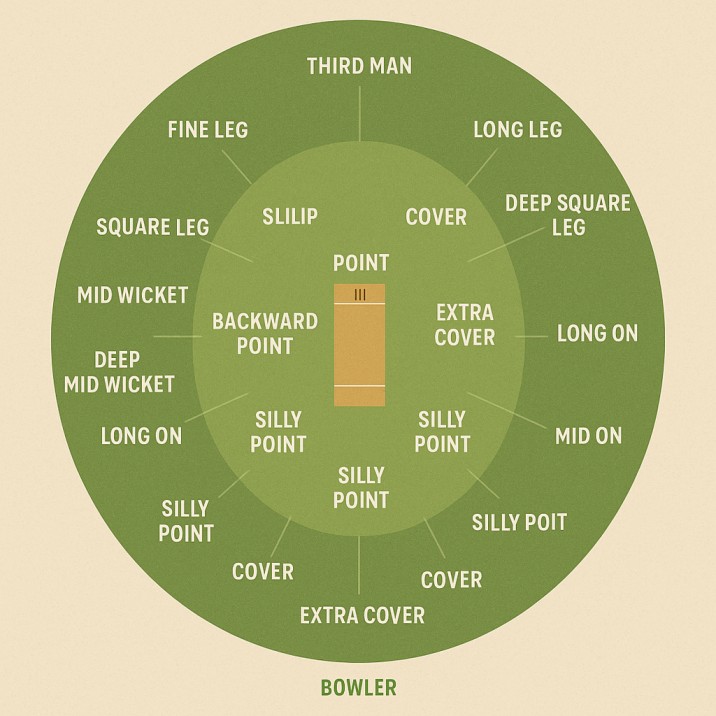
A standard cricket ground with pitch, boundary, and fielding area.
The Cricket Ground
Shape: Oval or circular ground (much larger than a football field) Center: 22-yard long rectangular pitch (20 meters) Boundary: Rope or fence marking the edge of the playing area Size: Typically 150-200 meters in diameter
The Playing Pitch
The pitch is the most important part of the cricket ground. It’s a 22-yard (20.12 meters) long strip in the center where most of the action happens:
Two Ends:
Striker’s End: Where the batsman facing the ball stands
Non-Striker’s End: Where the other batsman stands
Three Stumps at Each End:
Wooden stumps (posts) standing vertically
Two bails (small wooden pieces) balanced on top
Together called “wickets”
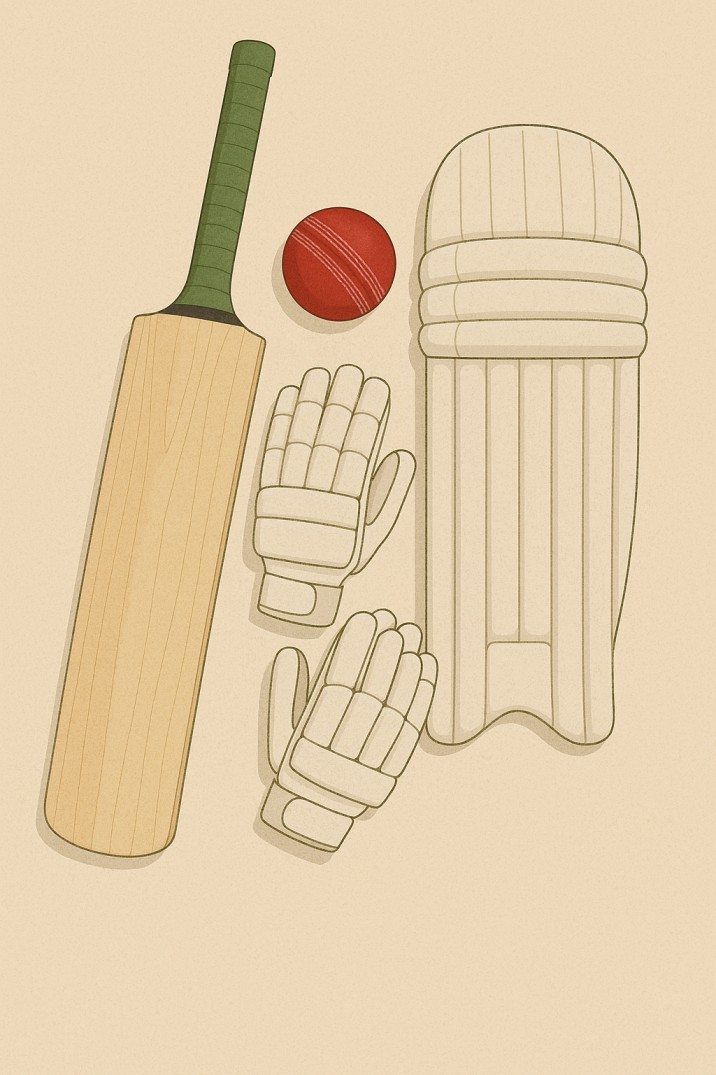
Essential cricket equipment used by batsmen and fielders.
Over 3: Bowler A (or C) bowls 6 balls from End 1 again
And so on…
Why Overs Matter
Different Cricket Formats:
Test Cricket: Unlimited overs (can go on for 5 days)
ODI (One Day International): 50 overs per side (300 balls each team)
T20 Cricket: 20 overs per side (120 balls each team)
The Hundred: 100 balls per side (relatively new format)
Extra Balls (Not Counted in Over)
Some balls don’t count toward the 6-ball over:
Wide Ball:
Ball bowled too far from batsman
Batsman can’t reach it reasonably
1 extra run given to batting team
Must be re-bowled
No Ball:
Bowler oversteps the crease line
Or bowls illegally (bent arm, wrong height)
1 extra run given to batting team
Must be re-bowled
Batsman can’t be out on a no-ball (except run-out)
Example: If bowler bowls 4 legal balls, then 1 wide, then 2 more legal balls, it’s STILL not a complete over. He needs 6 LEGAL balls, so he has to bowl 1 more.
wickets
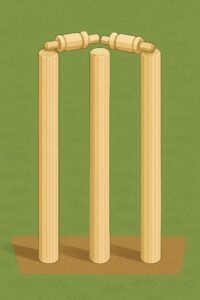
Close-up view of cricket stumps and bails used to dismiss a batsman.
Understanding Wickets in Cricket
The word “wicket” has THREE different meanings in cricket (confusing for beginners!):
Meaning 1: The Stumps and Bails
The physical structure at each end of the pitch:
3 wooden stumps standing vertically
2 bails balanced on top
Height: 28 inches (71.12 cm)
Width: 9 inches (22.86 cm)
Meaning 2: The Pitch Itself
Sometimes the playing surface is called “the wicket”:
“The wicket is turning” = The pitch helps spin bowlers
“Flat wicket” = Easy for batsmen, hard to get people out
Meaning 3: A Dismissal (Getting Out)
When a batsman gets out, it’s called “taking a wicket”:
“India lost 3 wickets” = 3 Indian batsmen got out
“Bowler took 5 wickets” = He got 5 batsmen out
Stumped Wicket vs Clean Bowled
Clean Bowled:
Ball hits the stumps directly
Bails fall off
Batsman out immediately
Most satisfying dismissal for bowlers
Stumped:
Batsman steps out of his crease
Misses the ball
Wicketkeeper catches ball and removes bails
Batsman out if foot outside crease
10 Ways a Batsman Can Get Out (Dismissals Explained)
1. Bowled (Clean Bowled)
What Happens:
Ball hits the stumps
Bails fall off
Batsman is OUT
Simple Explanation: The bowler successfully hit the “house” you were defending. You failed to protect the stumps.
Example: Virat Kohli tries to hit a big shot, misses the ball, ball hits middle stump, bails fly off – Kohli is OUT bowled.
Who Gets Credit: Bowler gets wicket
2. Caught
What Happens:
Batsman hits the ball in the air
Fielder catches it before it touches the ground
Batsman is OUT
Simple Explanation: Like catching a fly ball in baseball. If fielder holds the ball cleanly without dropping it, batsman is out.
Important Rules:
Must catch before ball touches ground
Fielder must have control of the ball
If ball touches ground while catching, NOT OUT
Can catch anywhere on the field (including boundary)
Example: MS Dhoni hits the ball high in the air, Virat catches it near the boundary – Dhoni is OUT caught.
Who Gets Credit: Bowler gets wicket + Fielder gets catch
3. LBW (Leg Before Wicket) – Most Confusing Rule!
What Happens:
Ball hits batsman’s leg/body
Umpire judges ball would have hit the stumps
Batsman is OUT
Simple Explanation: You can’t use your legs to protect the stumps. If the ball hits your leg and the umpire thinks it would have hit the stumps otherwise, you’re out.
Key Conditions for LBW (All Must Be Met):
Ball pitches in line with stumps or outside off stump (NOT outside leg stump)
Ball hits pad/body in line with stumps
Ball would have gone on to hit the stumps
Batsman didn’t hit the ball with bat first
Batsman wasn’t too far down the pitch
Why It’s Complicated: Umpire must judge in a split second whether the ball would have hit stumps. Now DRS (Decision Review System) technology helps.
Example: Rohit Sharma misses a straight ball, it hits his front pad right in front of stumps, umpire raises finger – Rohit is OUT LBW.
Who Gets Credit: Bowler gets wicket
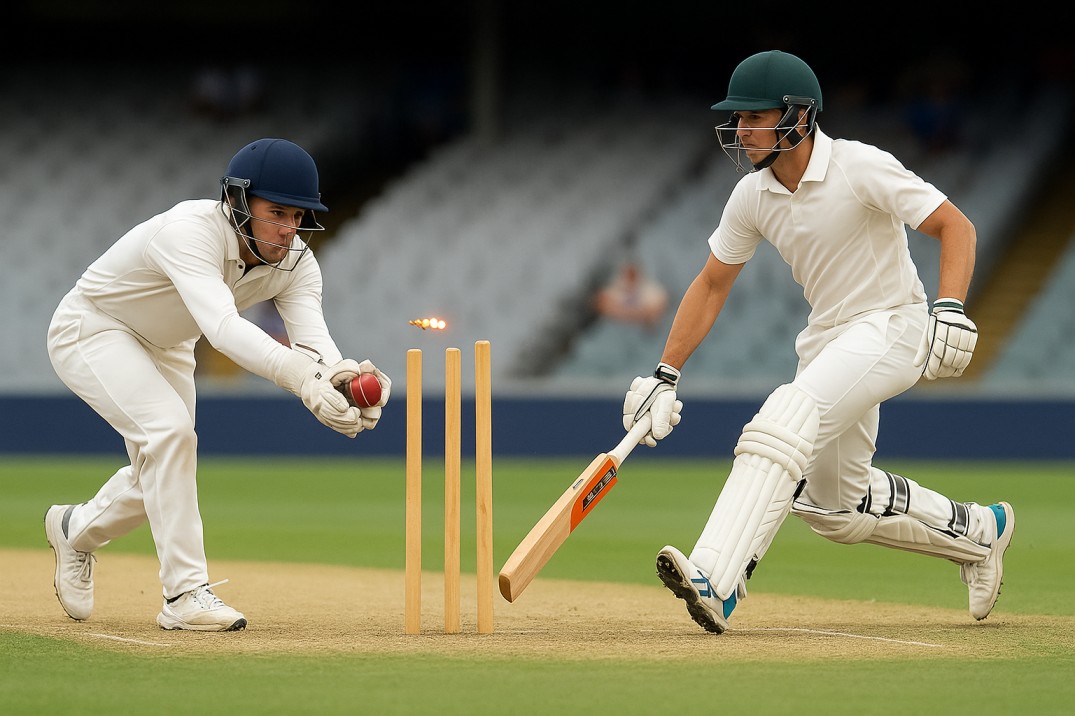
4. Run Out
What Happens:
Batsmen running between wickets
Fielder hits the stumps with ball
Batsman hasn’t reached the crease
Batsman is OUT
Simple Explanation: You’re racing to reach the safe zone (crease), but fielders break your “house” (stumps) before you arrive. Like being tagged out in baseball while running bases.
Common Scenarios:
Attempting risky single run
Confusion between batsmen
Brilliant fielding and direct throw
Backing up too far at non-striker’s end
Example: Hardik Pandya calls for a run, Ravindra Jadeja throws and hits the stumps, Hardik is short of the crease – Hardik is OUT run out.
Who Gets Credit: No bowler credit (fielder gets run-out credit)
A run out occurs when the batsman fails to reach the crease before the stumps are broken.
5. Stumped
What Happens:
Batsman steps out of his crease
Misses the ball completely
Wicketkeeper removes bails
Batsman is OUT
Simple Explanation: You left your “safe zone” (crease) to attack, missed the ball, and the wicketkeeper broke your “house” before you could get back.
Key Difference from Run Out:
Stumping: Batsman NOT attempting a run, just came out to hit
Run Out: Batsman IS running between wickets
Example: Rishabh Pant charges down the pitch to hit a spinner, misses, MS Dhoni collects and removes bails in 0.1 seconds – Pant is OUT stumped.
Who Gets Credit: Bowler + Wicketkeeper
6. Hit Wicket
What Happens:
Batsman accidentally hits his own stumps
With bat or body
Bails fall off
Batsman is OUT
Simple Explanation: You destroyed your own “house” by accident. It’s like scoring an own goal in football.
Common Ways:
Stepping back and hitting stumps with foot
Bat touches stumps while playing shot
Helmet falls on stumps
Losing balance after playing shot
Example: KL Rahul plays a pull shot, steps back, his foot touches the stumps, bails fall – Rahul is OUT hit wicket.
Who Gets Credit: Bowler gets wicket
7. Caught Behind (Specific Type of Caught)
What Happens:
Batsman edges the ball
Wicketkeeper catches it
Batsman is OUT
Simple Explanation: Same as “caught” but specifically when wicketkeeper catches. Called “caught behind” because wicketkeeper stands behind the batsman.
Common Scenario:
Fast bowler delivers outside off stump
Batsman tries to play shot
Ball takes thin edge of bat
Wicketkeeper dives and catches
Umpire gives out
Appeal Sound: You’ll often hear fielders shouting “Howzzat!” or “Catch it!” when they think there’s an edge.
Example: Babar Azam edges a ball, Rishabh Pant catches behind stumps – Babar is OUT caught behind.
Who Gets Credit: Bowler + Wicketkeeper
8. Handled the Ball (Very Rare)
What Happens:
Batsman touches ball with hand
Intentionally (not while holding bat)
Without fielder permission
Batsman is OUT
Simple Explanation: You can’t use your hands to move the ball (unless protecting your wicket). This rule prevents batsmen from stopping the ball rolling toward stumps with hands.
When It’s Allowed:
Returning ball to fielder after playing shot (if you ask first)
Protecting yourself from injury
When It’s NOT Allowed:
Stopping ball from hitting stumps with hand
Preventing fielder from catching with hand
Example: Ball hits batsman’s pad, rolling toward stumps, batsman panics and picks up ball with hand – batsman is OUT handled the ball.
Who Gets Credit: No one (rare dismissal)
9. Hit the Ball Twice (Extremely Rare)
What Happens:
Batsman hits ball once
Then hits it again
Without intent to protect wickets
Batsman is OUT
Simple Explanation: You can only hit the ball once per delivery. Second hit is not allowed (unless protecting your stumps).
When It’s Allowed:
Defending stumps from ball rolling back
When It’s NOT Allowed:
Trying to score more runs
Hitting ball second time for any other reason
Example: This is SO rare you’ll probably never see it in modern cricket.
Who Gets Credit: No one (very rare dismissal)
10. Obstructing the Field (Rare)
What Happens:
Batsman deliberately blocks fielder
Prevents catch or run-out
Batsman is OUT
Simple Explanation: You can’t intentionally stop fielders from doing their job. Fair play rule.
Examples:
Changing running line to block fielder’s throw
Deliberately getting in way of fielder catching ball
Verbal obstruction
Example: Batsman running, fielder about to throw at stumps, batsman deliberately blocks the throw with his body – batsman is OUT obstructing field.
Who Gets Credit: No one (rare dismissal)
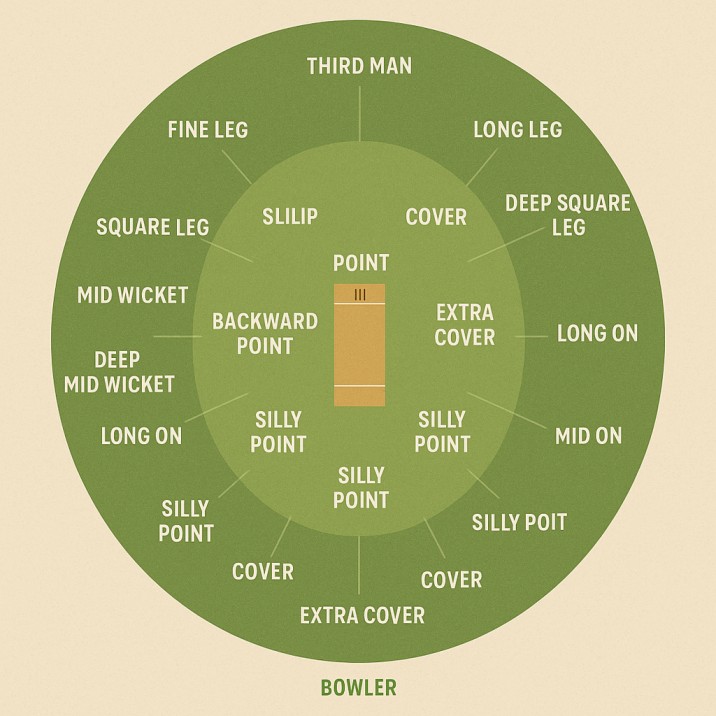
Diagram explaining off side and leg side fielding positions in cricket.
Cricket Fielding Positions Explained with Diagram
Understanding fielding positions helps you follow the game better. There are roughly 30-35 named fielding positions, but beginners only need to know the main ones.
Basic Position Categories
1. Close-In Fielders (Near Batsman)
Silly Point: Very close on off side
Short Leg: Very close on leg side
Slip Cordon: Behind batsman on off side (slip, second slip, third slip)
Gully: Between slips and point
Purpose: Catch edges and deflections
2. Ring Field (Medium Distance)
Cover: Off side, in front of batsman
Mid-Off: Straight, in front of batsman on off side
Mid-On: Straight, in front of batsman on leg side
Square Leg: Side-on to batsman on leg side
Point: Side-on to batsman on off side
Purpose: Stop singles, quick runs
3. Boundary Fielders (On the Fence)
Long Off: Straight boundary on off side
Long On: Straight boundary on leg side
Deep Mid-Wicket: Leg side boundary
Third Man: Behind batsman on off side near boundary
Fine Leg: Behind batsman on leg side near boundary
Purpose: Stop boundaries (fours and sixes)
Off Side vs Leg Side (IMPORTANT)
Off Side:
Right side of right-handed batsman (facing bowler)
Left side of left-handed batsman
Area where bat points when held normally
Leg Side (On Side):
Left side of right-handed batsman
Right side of left-handed batsman
Area where legs are
Why It Matters: Fielding positions are described based on off/leg sides, so understanding this is crucial.
Special Fielding Position: Wicketkeeper
Position: Always behind the stumps at striker’s end Role: Catch balls batsman misses or edges Equipment: Special gloves and pads Importance: Most dismissals involve wicketkeeper (caught behind, stumped)
Cricket Scoring System Explained Simply
How Runs Are Scored
1. Running Between Wickets:
Hit ball, run to other end = 1 run
Turn around, run back = 2 runs
Can continue running = 3 runs (rare, only on big grounds)
2. Boundary Scoring:
Ball bounces and crosses boundary = 4 runs (automatically)
Ball crosses boundary without bouncing = 6 runs (automatically)
No need to run
3. Extras (Given to Batting Team, Not Individual Batsman):
Wide: Ball too far to reach = 1 extra run
No Ball: Illegal delivery = 1 extra run (plus free hit in limited-overs)
Byes: Ball passes batsman and wicketkeeper = runs scored
Leg Byes: Ball hits batsman’s body (not bat), runs scored
Example Scorecard Breakdown
Let’s say Virat Kohli’s score shows: 89 (67)
What It Means:
89 = Total runs scored
67 = Balls faced
Strike Rate Calculation:
Strike Rate = (Runs ÷ Balls) × 100
Kohli’s Strike Rate = (89 ÷ 67) × 100 = 132.83
What’s Good Strike Rate:
Test Cricket: 50-60 is good, 40+ acceptable
ODI Cricket: 80-100 is good
T20 Cricket: 120-150 is good, 150+ is excellent
Team Score Example
India: 287/5 (50 overs)
Breaking It Down:
287 = Total runs scored by India
5 = Wickets lost (5 batsmen out)
50 overs = Total overs bowled
Reading: “India scored two hundred eighty-seven runs for the loss of five wickets in fifty overs.”
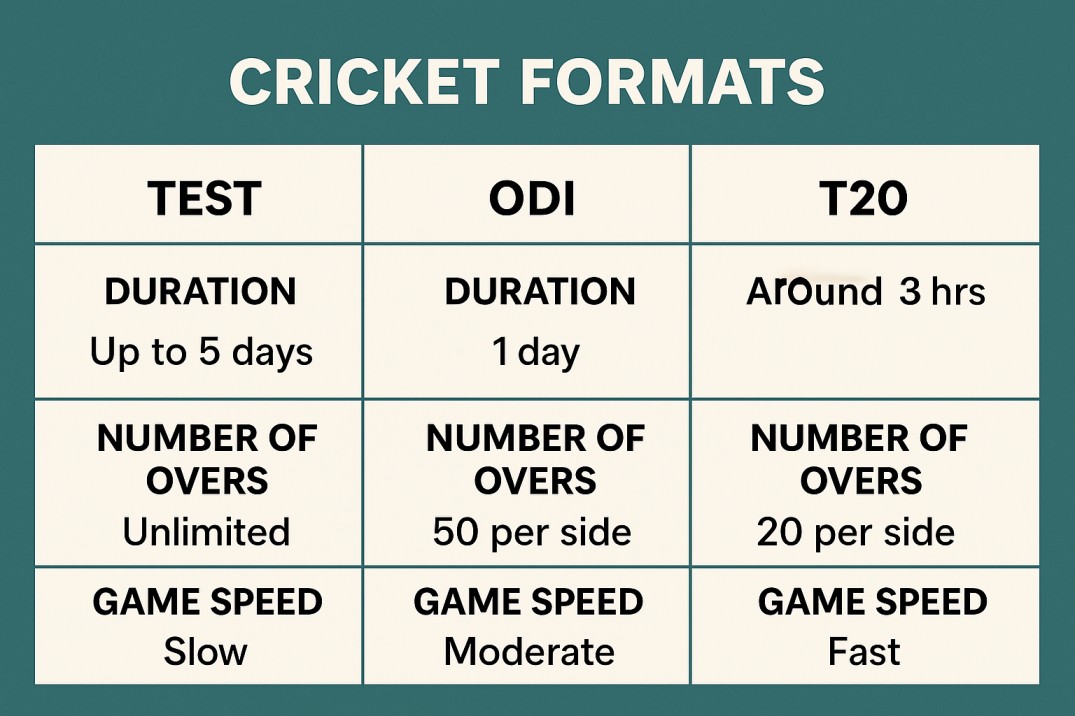
Infographic comparing Test cricket, ODI and T20 formats.
Different Formats of Cricket Explained
1. Test Cricket (Traditional, Longest Format)
Duration: Up to 5 days (6 hours per day) Overs: Unlimited (90 overs per day minimum) Innings: 2 per team Uniform: White clothing, red ball Result: Win, Loss, Draw, or Tie
Duration: One day (about 7-8 hours) Overs: 50 overs per team (300 balls each) Innings: 1 per team Uniform: Colored clothing, white ball Result: Win or Loss (very rarely Tie)
Why It’s Popular:
Perfect balance between Test and T20
Complete in one day
ICC Cricket World Cup is ODI format
Tactical gameplay
Example: India vs Pakistan in ICC World Cup (50-over match)
3. T20 – Twenty20 (Shortest Format)
Duration: About 3 hours Overs: 20 overs per team (120 balls each) Innings: 1 per team Uniform: Colored clothing, white ball Result: Win or Loss
Why It’s Most Popular:
Fast-paced entertainment
Fits modern lifestyle (3 hours)
IPL (Indian Premier League) is T20 format
High scoring, exciting
Example: Mumbai Indians vs Chennai Super Kings in IPL (T20 match)
Quick Comparison
Format
Duration
Overs
Ball Color
Clothing
Pace
Test
5 days
Unlimited
Red
White
Slow, Strategic
ODI
1 day
50 per side
White
Colored
Moderate
T20
3 hours
20 per side
White
Colored
Fast, Aggressive
Basic Cricket Terminology Every Beginner Should Know
Batting Terms
Duck: Batsman getting out without scoring any runs (0 runs) = “He got a duck” Golden Duck: Getting out on the very first ball faced Half-Century (50): Scoring 50 runs – good performance Century (100): Scoring 100 runs – excellent performance Double Century (200): Scoring 200 runs – rare, exceptional Maiden Over: Over where no runs are scored by batsman Strike Rate: Runs scored per 100 balls faced
Bowling Terms
Yorker: Ball pitched right at batsman’s feet (hardest to hit) Bouncer: Short-pitched ball aimed at batsman’s head/shoulder Full Toss: Ball reaches batsman without bouncing (easy to hit) Dot Ball: Ball where no run is scored Hat-Trick: Bowler taking 3 wickets in 3 consecutive balls (very rare!) Five-Wicket Haul (5-fer): Bowler taking 5 wickets in an innings (excellent) Economy Rate: Runs given per over by bowler
Fielding Terms
Clean Bowled: Ball hitting stumps directly Caught Behind: Wicketkeeper catching the ball Edge: Ball touching the edge of bat Drop: Fielder failing to catch a catchable ball Run Out: Dismissal by hitting stumps while batsmen running Direct Hit: Fielder hitting stumps with throw (without collecting)
General Terms
Innings: One team’s turn to bat (plural is also “innings”) Follow-On: In Test cricket, team batting again immediately after being all out (only if they’re 200+ runs behind) Declaration: Captain ending innings voluntarily (Test cricket only) Review (DRS): Team challenging umpire’s decision using technology Powerplay: First 10 overs in ODI (first 6 in T20) where only 2 fielders allowed outside 30-yard circle
How to Watch and Understand Cricket Matches
What to Watch For
1. The Scoreboard:
Current score (Runs/Wickets)
Overs bowled
Current batsmen’s individual scores
Required run rate (in run chases)
2. Field Placements:
Are fielders close in (bowling team expects edges/catches)?
Are fielders on boundary (expecting big hits)?
Changes tell you bowler’s strategy
3. Bowler’s Action:
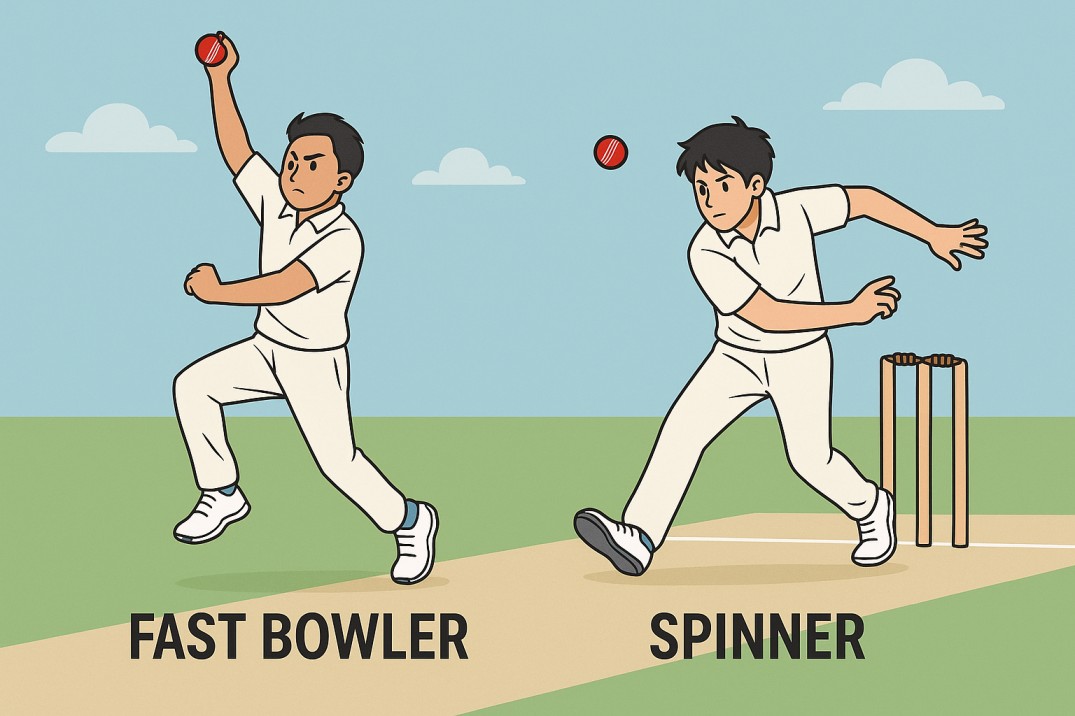
Fast bowler: Long run-up, speed 130-150 km/h
Medium pacer: Shorter run-up, 110-130 km/h
Spinner: Very short run-up, flight and turn
4. Batsman’s Footwork:
Good footwork = moving feet to ball position
Poor footwork = getting stuck, edges likely
Common Match Situations Explained
Building Innings (Test/ODI):
Batsmen playing carefully
Not taking risks early
Building partnership
Singles and doubles, occasional boundary
Death Overs (ODI/T20):
Last 5-10 overs
Batsmen hitting aggressively
Every ball attempts boundary
Bowlers trying yorkers
Run Chase:
Required Run Rate shown on screen
If RRR is 8.5, team needs 8.5 runs per over
Pressure increases if rate climbs
New Ball (Test):
New ball every 80 overs in Test
Swings more, faster
Dangerous for batsmen
Tips for Beginners to Enjoy Cricket
1. Start with T20 Format
Don’t jump into Test cricket immediately:
T20 is fast, exciting, easy to follow
Completed in 3 hours
Watch IPL to understand quickly
Learn players, rules, excitement
2. Follow One Team
Makes it easier to stay engaged:
Choose national team (India)
Or IPL franchise (Mumbai Indians, CSK)
Learn about players
Emotional investment increases enjoyment
3. Watch with Experienced Fan
Cricket fans love explaining:
Ask questions freely
They’ll explain situations as they happen
Real-time learning is fastest
4. Play Cricket Video Games
Games like EA Cricket or Real Cricket:
Learn rules by playing
Understand field placements
Practice bowling/batting strategies
Fun way to learn
5. Learn Gradually
Don’t try to understand everything at once:
Day 1: Understand basic concept (runs, wickets, overs)
Week 1: Learn dismissal types
Month 1: Understand field placements
Month 2: Appreciate strategies and nuances
6. Ignore Complex Statistics Initially
Cricket has TONS of statistics:
Ignore batting average, economy rate, etc. initially
Focus on who’s winning, how many runs needed
Statistics appreciation comes naturally later
Common Questions Beginners Ask
Why Do They Keep Changing Bowlers?
Bowling Restrictions:
In ODI: No bowler can bowl more than 10 overs (out of 50)
In T20: No bowler can bowl more than 4 overs (out of 20)
Captains rotate bowlers to find best combinations
Different bowlers for different situations (spinners vs fast bowlers)
What Happens If Weather Interrupts?
Rain Delays:
In Test: Play resumes when weather clears, days can be extended
In ODI/T20: DLS Method (Duckworth-Lewis-Stern) recalculates target
Match can be shortened (e.g., 50 overs reduced to 35)
If too much lost, match abandoned
Why Do Fielders Stand So Close Sometimes?
Close-In Fielders:
When bowling spin, fielders stand close (silly point, short leg)
Expect ball to turn, batsman to edge
Brave fielders wear helmets even while fielding!
High-risk, high-reward positioning
What’s That White Line On Pitch?
Crease Lines:
Batting Crease: Line batsman must be behind (safe zone)
Bowling Crease: Line bowler must not overstep (else no-ball)
Return Crease: Side boundaries for bowler
Very important for run-outs, stumpings, no-balls
Why Do They Shine Ball on Clothes?
Ball Maintenance:
Natural wear makes ball rough on one side
Shining one side keeps it smooth
Creates difference = ball swings in air
Legal and encouraged!
Only saliva/sweat allowed (no foreign substances)
FAQ: Basic Rules of Cricket for Beginners
How many players are there in a cricket team?
Each cricket team has exactly 11 players. During batting, only 2 batsmen are on the field at a time, with the remaining 9 waiting in the pavilion. When bowling, all 11 players from the fielding team are on the field – 1 bowler, 1 wicketkeeper, and 9 fielders positioned around the ground.
How do you score runs in cricket?
There are two main ways to score runs in cricket: (1) Running between wickets – after hitting the ball, both batsmen run to the opposite end. Each completed run equals 1 run, and they can run multiple times. (2) Hitting boundaries – if the ball crosses the boundary rope after bouncing, it’s 4 runs automatically. If it crosses without bouncing, it’s 6 runs. Additionally, extras like wides and no-balls add runs to the team total.
What does LBW mean in cricket?
LBW stands for “Leg Before Wicket” – the most confusing rule for beginners. A batsman is out LBW when the ball hits his leg or body (instead of the bat), and the umpire judges that the ball would have hit the stumps if the leg wasn’t there. Think of it as: you can’t use your legs to protect the stumps. The umpire considers where the ball pitched, where it hit the pad, and whether it would have hit the stumps.
How many overs are there in cricket?
The number of overs depends on the cricket format: Test cricket has unlimited overs (typically 90 per day for 5 days), ODI (One Day International) has 50 overs per team (300 balls), T20 cricket has 20 overs per team (120 balls), and The Hundred has 100 balls per team. One over equals 6 legal deliveries bowled by one bowler from one end.
What is the difference between Test and ODI cricket?
Test cricket is played over 5 days with unlimited overs, 2 innings per team, white clothing and a red ball, and can end in a draw. ODI (One Day International) is completed in one day with 50 overs per team, 1 innings per team, colored clothing and a white ball, and must have a winner (no draws). Test cricket is considered more prestigious and strategic, while ODI offers balance between tradition and entertainment.
Can a batsman be out on a no-ball?
No, a batsman generally cannot be dismissed on a no-ball with a few rare exceptions. On a no-ball, the batsman is safe from being bowled, caught, LBW, or stumped. However, a batsman CAN still be run out on a no-ball if attempting a run. The batting team gets 1 extra run for the no-ball, the ball must be re-bowled, and in limited-overs cricket, the next ball is a “free hit” where the batsman can only be run out.
What is a maiden over in cricket?
A maiden over is when a bowler completes all 6 legal deliveries in an over without the batsman scoring any runs from the bat. Extras like wides and no-balls don’t count, but byes and leg-byes do prevent a maiden. Maiden overs are significant in all formats but especially valued in Test cricket, showing the bowler’s control and putting pressure on batsmen. Commentators track maiden overs as a measure of bowling discipline.
How does the wicketkeeper differ from other fielders?
The wicketkeeper is the only fielder allowed to wear gloves and stand directly behind the stumps at the striker’s end. He wears special wicketkeeping gloves with webbing and padded protection, and leg pads similar to batting pads. The wicketkeeper’s role is crucial – he catches balls the batsman misses or edges (caught behind dismissals) and stumps batsmen who leave their crease. Most dismissals involve the wicketkeeper, making it one of the most important positions.
What is the powerplay in cricket?
Powerplay refers to specific overs in limited-overs cricket where fielding restrictions apply. In ODI cricket, the first 10 overs are mandatory powerplay (only 2 fielders allowed outside the 30-yard circle), creating opportunities for batsmen to score quickly. In T20 cricket, the powerplay is the first 6 overs. During powerplay, you’ll see more attacking batting and close-in fielders. After powerplay ends, up to 5 fielders can be placed outside the circle.
Comparison of fast bowling and spin bowling actions in cricket.
How to Practice Cricket at Home for Beginners
For Batting Practice
1. Shadow Batting:
Stand in front of mirror
Practice batting shots without ball
Focus on correct technique
Check backlift, foot movement, follow-through
15-20 minutes daily improves muscle memory
2. Tennis Ball Against Wall:
Use old cricket bat or tennis racket
Throw tennis ball against wall
Practice timing as it rebounds
Improves hand-eye coordination
Safe for indoor practice
3. Batting Tee:
Place ball on cone or tee
Practice driving shots
Focus on straight bat technique
Great for beginners learning basic shots
For Bowling Practice
1. Target Practice:
Mark target on wall (about stump height)
Bowl tennis ball at target
Focus on accuracy before speed
30 deliveries per session
2. Run-Up Rhythm:
Practice bowling action without ball
Smooth run-up important
Film yourself, check straight arm
Build comfortable rhythm
3. Grip Practice:
Hold cricket ball correctly
Seam bowling: Index and middle finger on seam
Spin bowling: Various grips for different spins
Practice grip anytime during day
Fitness for Cricket
1. Running and Stamina:
Cricket requires good fitness
Run 2-3 km regularly
Builds stamina for batting/bowling
Quick sprints for running between wickets
2. Flexibility:
Stretch before practice
Reduces injury risk
Improves shot range
10-15 minutes stretching essential
3. Core Strength:
Planks, sit-ups, leg raises
Strong core helps batting power
Improves bowling speed
Better balance while fielding
Understanding Cricket Commentary Terms
When watching cricket, commentators use specific terms that might confuse beginners. Here are the most common ones explained:
Shot Names
Straight Drive: Hitting ball straight back past bowler (beautiful shot) Cover Drive: Hitting through covers on off side (elegant shot) Pull Shot: Hitting short ball to leg side (powerful) Hook Shot: Similar to pull, ball chest/head height Cut Shot: Hitting short ball on off side behind point Sweep: Getting down on one knee, hitting to leg side (against spinners) Reverse Sweep: Sweep shot to off side instead of leg side Slog: Big agricultural heave across the line (risky but effective)
Bowling Terms
Swing Bowling: Ball moves in air (conventional swing = moves away from batsman, reverse swing = moves toward batsman) Seam Bowling: Ball deviates after pitching on seam Spin Bowling: Ball turns after bouncing (off-spin = turns into right-hander, leg-spin = turns away from right-hander) Googly: Leg spinner’s delivery that turns opposite direction (tricks batsman) Doosra: Off spinner’s delivery turning opposite way Slower Ball: Bowler deceiving batsman by reducing pace
Field Placement Phrases
Third Man: Fielder behind batsman on off side near boundary Fine Leg: Fielder behind batsman on leg side near boundary Cow Corner: Midwicket boundary area (where cows graze!) Covers: Off side field, between point and mid-off Slips: Fielders standing behind batsman on off side in arc
Cricket Etiquette and Spirit of the Game
Cricket has unwritten rules called “Spirit of Cricket” that players are expected to follow:
Walking
Concept: Batsman knowing he’s out and walking off without waiting for umpire’s decision When: After edging catch, especially in Test cricket Reality: More common in club cricket; professionals usually wait for umpire
Not Claiming Unfair Catches
Concept: Fielder admitting ball touched ground during catch Spirit: Honesty over winning at any cost Example: Fielder telling umpire “I’m not sure if that was clean”
Congratulating Opposition
Concept: Applauding good play even by opponents When: Opposition century, five-wicket haul, brilliant catch Shows: Respect for the game and players
Not Sledging Excessively
Sledging: Verbal tactics to disturb batsman’s concentration Acceptable: Light banter, competitive chat Unacceptable: Personal abuse, racial comments, excessive aggression Modern Rules: ICC penalizes bad behavior
Respecting Umpire Decisions
Concept: Accepting umpire’s decision even if you disagree Why: Umpire’s decision is final (except DRS reviews) Professional: Players may be disappointed but must leave quietly
Famous Cricket Tournaments Beginners Should Know
1. ICC Cricket World Cup (ODI)
Format: One Day International (50 overs) Frequency: Every 4 years Teams: Top cricket nations (10-16 teams) Prestige: Highest prize in ODI cricket Recent Winners: England (2019), Australia (2023) Next: 2027
Format: Twenty20 (20 overs) Frequency: Every 2 years Teams: 16 teams (includes qualifiers) Entertainment: Fast-paced, high-scoring Recent Winners: England (2022), India (2024)
3. Indian Premier League (IPL)
Format: T20 franchise league When: April-May every year Teams: 10 franchises (Mumbai Indians, CSK, RCB, etc.) Prize Money: Highest in cricket Popularity: Most-watched cricket league globally Feature: Mixes international and Indian players
4. The Ashes (Test Series)
Teams: England vs Australia only Format: Test cricket (5 matches) History: Oldest cricket rivalry (since 1882) Frequency: Every 2 years (alternating countries) Prestige: Most famous Test series
5. Big Bash League (BBL)
Format: T20 franchise league (Australia) When: December-February (Australian summer) Teams: 8 Australian city-based franchises Feature: Family entertainment, innovations Popularity: Second most popular T20 league after IPL
6. Pakistan Super League (PSL)
Format: T20 franchise league (Pakistan) Teams: 6 franchises Growing: Rapidly increasing quality and viewership
7. The Hundred (England)
Format: 100-ball cricket (new format) Teams: 8 city-based teams (men’s and women’s) Innovation: Trying to attract new audiences Unique: 100 balls instead of 120 (not measured in overs)
Congratulations! You’ve completed this comprehensive guide to basic rules of cricket explained for beginners. You now understand how cricket is played, the different ways batsmen can get out, how runs are scored, what overs and wickets mean, fielding positions, different cricket formats, and essential terminology that will help you follow matches with confidence.
Cricket is a beautiful game that rewards patience, skill, strategy, and temperament. What seems complicated at first becomes second nature once you watch a few matches with this knowledge. The best way to learn is by doing – watch IPL matches starting in April, follow your favorite players, attend live cricket if possible, or even try playing with friends using a tennis ball in your local park.
Remember these key points as you begin watching cricket: Start with T20 format for fast entertainment, don’t worry about understanding everything immediately, ask questions when watching with experienced fans, focus on the basic scoreboard first (runs, wickets, overs), and most importantly, enjoy the drama and excitement that makes cricket one of the world’s most beloved sports.
The cricket community is welcoming and passionate. Whether you’re watching Mumbai Indians chase down a target in the last over of an IPL match, India defending a modest total against Pakistan in a World Cup thriller, or England and Australia battling for the Ashes in a five-day Test match – you’ll now understand what’s happening and why millions of fans around the world can’t take their eyes off the game.
Welcome to the wonderful world of cricket. The pitch awaits, the ball is in the bowler’s hand, and you’re now ready to enjoy every moment of this incredible sport. Play on!
Additional Resources for Learning Cricket
YouTube Channels
ESPNcricinfo: News, analysis, highlights
ICC (International Cricket Council): Official highlights